Child Actor Self-Tapes: Which Take Should You Actually Send?
If your living room now doubles as a casting studio—ring light on, blank wall ready, 27 takes sitting on your phone—you’re not alone.
Self-taping gives you control.
And then immediately overwhelms you with options.
Because now the question isn’t can we get it?
It’s which one is it?
Let’s simplify how to choose the right take—the one casting actually leans toward.
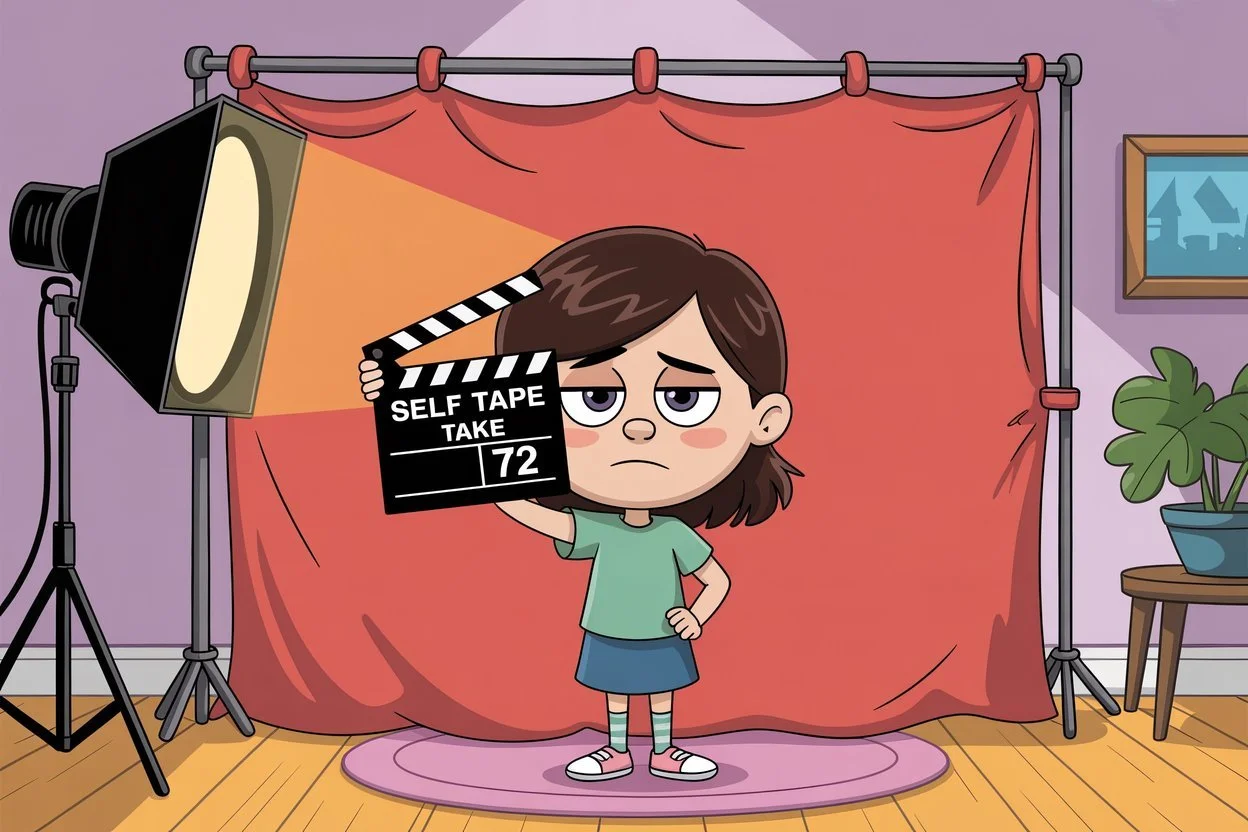
Stop Watching Like a Parent. Start Watching Like Casting.
Parents watch for mistakes.
Casting watches for connection.
That shift alone changes everything.
You’re not looking for:
perfect hair
perfect diction
zero stumbles
You’re looking for:
Does this feel like a real person in a real moment?
A take that feels alive—with a tiny stumble—is far more valuable than a clean, forgettable read.
If it’s engaging, specific, and grounded… it wins.
The First Few Seconds Decide Everything
This is where most tapes quietly lose.
Casting is watching hundreds.
They are not easing into your child’s performance.
They’re deciding—fast.
So ask yourself:
Do we feel something immediately?
Is there a point of view right away?
Is this specific, or generic?
If the beginning feels flat, neutral, or “warmed up”…
it’s not the take.
You want the one that starts mid-thought, like we’ve dropped into something already happening.
Look for Behavior, Not Line Reading
A strong take isn’t about how the lines sound.
It’s about what your child is doing.
Are they:
reacting?
adjusting?
thinking?
shifting emotionally?
Or are they just… delivering?
Casting is drawn to behavior.
The little moments between the lines. The reactions. The changes.
If one take feels more active—even if it’s less “perfect”—that’s usually your winner.
Don’t Chase Perfection and Lose the Spark
This is one of the biggest traps.
You get a take that feels fresh. Alive. Interesting.
But there’s a tiny mistake.
So you go again.
And again.
And slowly… the life drains out of it.
You’re no longer capturing something.
You’re trying to recreate it.
That almost never works.
Think of it like catching lightning in a jar.
You don’t say, “Let’s do that exact lightning again, but cleaner.”
You take the lightning.
If a take had energy, spontaneity, and truth—even with a small flaw—
that’s the one you protect.
The Three-Take Rule (Save the Performance Before It Gets Overworked)
There’s a point where more takes don’t improve anything.
They just make it heavier. More controlled. Less instinctual.
Think of it like explaining a joke.
First time? It lands.
Second time? Still okay.
By the fifth time, you’re pushing it—and it dies.
Same thing here.
Do three takes. Then stop and review.
If something’s not working, adjust and try again.
But don’t keep rolling endlessly hoping it magically improves.
It usually goes the other direction.
When You’re Torn Between Two Takes
This happens all the time.
One take is:
cleaner
technically solid
safe
The other is:
more interesting
more specific
maybe a little messy
Choose the interesting one.
Casting remembers interesting.
They don’t remember “solid.”
A Quick Note on Sending Two Takes
Yes—I’m a fan of sending two takes.
But only if they earn it.
If you’re sending two, they should feel like two different interpretations, not a slightly adjusted version of the same read.
Think of it like showing casting two different sides of the same character:
one more open, one more guarded
one lighter, one more grounded
Not better vs. worse—just different points of view.
If they feel too similar, send one.
Trust the Take That Holds Your Attention
At the end of the day, this isn’t complicated.
One take will pull you in more than the others.
You’ll stop analyzing it… and just watch it.
That’s the one.
Not the most controlled.
Not the most polished.
The one that feels like something is actually happening.
Need Feedback To Help You Choose?
For less than the cost of lunch you can get professional feedback on your child’s self tapes - same day. Check it out!
FAQ
My child messed up a word, but the take felt great. Do we redo it?
No.
If the performance is strong, send it. Small imperfections don’t cost jobs—boring choices do.
Casting didn’t specify how many takes. What should we do?
Send one strong take.
If you have a second that is clearly different and just as strong, include it.
We recorded a lot of takes. Can we send multiple options?
No.
Your job is to choose—not to show everything.
Should my child look into the camera?
No.
Keep the eyeline just off-camera so we can see them clearly while still believing the scene.
Choosing a take isn’t about finding the cleanest version.
It’s about recognizing the one that feels alive.
The one that grabs you.
The one that has behavior.
The one that feels like it’s actually happening.
That’s the one casting is looking for.
Send that.