What Casting Directors Look for in the First 20 Seconds of an Audition
In a recent interview on Still Here Hollywood, veteran casting director Paul Ruddy said something every actor parent should probably write on a Post-it and stick somewhere near the self-tape setup:
Casting can often tell within the first twenty seconds whether an actor understands the role.
Comforting? Not especially.
Useful? Extremely.
Paul Ruddy has been casting for more than twenty-seven years across film, television, Lifetime movies, and now the emerging world of vertical micro-dramas. He started on the agency side before moving into casting, where he has helped discover and hire actors at every level, from first professional jobs to major career-changing roles. In the interview, he talks about giving Sydney Sweeney some of her early jobs, watching actors grow over time, and seeing the industry shift from in-person audition rooms to the self-tape era we are all living in now.

Casting Director Paul Ruddy
So when someone like Ruddy says casting knows quickly, parents should listen.
Not panic.
Listen.
Because this does not mean your child has twenty seconds to tap dance, cry on cue, charm the wallpaper, and prove they are the second coming of Shirley Temple with better Wi-Fi.
It means something simpler and much more important.
Casting can tell very quickly whether the actor walked into the tape with a point of view.
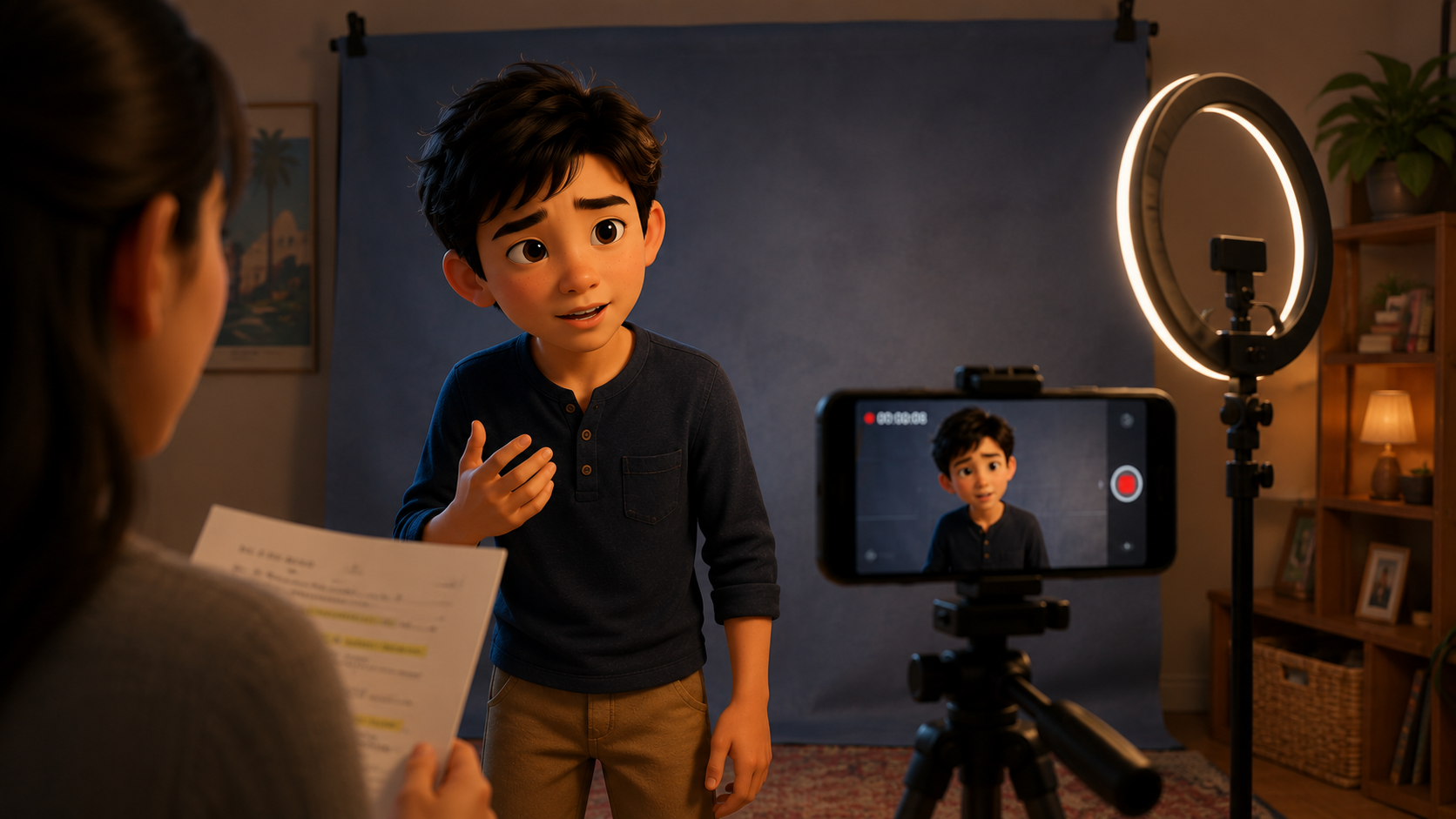
The Audition Begins Before the First Line
One of the biggest mistakes young actors make is waiting for the scene to begin.
They slate.
They reset their face.
They hear the reader’s first line.
Then, suddenly, they “start acting.”
But characters do not begin existing because someone gave them a cue.
A real person enters a moment already carrying something. They have just come from somewhere. They want something. They are avoiding something. They have a history with the person in front of them, even if that history is only three seconds old and mostly irritation.
That is what those first twenty seconds reveal.
Not whether the actor is perfect.
Not whether the lighting is expensive.
Not whether the backdrop has been steamed into submission like it’s preparing for a royal portrait.
The first twenty seconds reveal whether the actor knows where they are, who they are, what they want, and what kind of story they have stepped into.
That is the difference between a child saying lines and a young actor entering a scene.
Casting Is Looking for Clarity, Not Perfection
Parents often think casting is sitting there with a tiny clipboard of doom, marking every flubbed word, blink, and awkward hand movement.
They are not.
Casting wants the actor to be good.
That is one of the most important things Paul Ruddy makes clear in the interview. Casting directors are not rooting against your child. They are hoping someone walks in — or uploads a tape — and solves the problem.
That problem is the role.
A casting director has a character-shaped hole in the project. They are looking for the actor who makes that role make sense.
And clarity helps them see it.
A clear actor tells us, almost immediately:
This is who I am.
This is what I want.
This is how I feel about the person I am talking to.
This is the tone of the world I am in.
That kind of clarity does not have to be flashy. In fact, it usually should not be. But it does have to be present.
A vague audition is hard to cast.
A specific audition gives casting something to hold onto.
Tone Is the Invisible Contract
One of the fastest ways for an audition to go sideways is when the actor is performing in the wrong show.
This happens constantly.
The scene is written like a grounded single-camera drama, but the actor plays it like they are waiting for a laugh track and a wacky neighbor entrance.
Or the scene is a heightened comedy, and the actor drags it into a dimly lit emotional basement where all jokes go to be buried.
Tone matters.
Casting is not only asking, “Can this child act?”
They are asking, “Does this child belong in this world?”
That is why homework matters. If your child is auditioning for an existing show, watch the show. If it is a procedural, understand the rhythm. If it is a sitcom, understand the pace. If it is a vertical drama, understand that the storytelling may be faster, bigger, and built around constant cliffhangers.
A good actor adjusts to the world of the project.
They do not drag every script into the same acting soup and hope casting enjoys the seasoning.
Neutral Is Not the Same as Natural
Some young actors are so afraid of making the wrong choice that they make no choice at all.
They keep everything clean, polite, and emotionally beige.
Parents may look at that and think, “Well, at least they didn’t overdo it.”
True.
But they also may not have done enough.
Neutral can feel safe in the room, but on camera it often reads as empty. The goal is not to be huge. The goal is to be specific.
Specificity is what makes a performance feel alive.
A specific actor has opinions. A specific actor listens differently depending on who is speaking. A specific actor knows whether they are trying to win, hide, charm, deflect, confess, punish, or escape.
That does not require melodrama.
It requires intention.
Young actors do not need to be louder. They need to be clearer.
Memorization Is the Floor, Not the Finish Line
Paul Ruddy was blunt about this in the interview: if actors do not know the words, they cannot really do the job.
That may sound harsh, but it is true.
Memorization is not the final achievement. Memorization is what allows the acting to begin.
When a child is still chasing lines in their head, they are not fully listening. They are not truly reacting. They are not available for adjustments. They are not free enough to make discoveries.
They are doing mental gymnastics while trying to look emotionally available, which is a lot to ask of anyone, let alone a twelve-year-old standing in front of a blue wall while their parent whispers, “Bigger, but smaller.”
Once the words are solid, the actor can finally play.
They can listen.
They can respond.
They can let thoughts cross their face.
They can make the scene feel like it is happening for the first time instead of being recited from memory like a haunted spelling bee.
That is why being off book matters.
Not because casting is obsessed with perfection, but because freedom lives on the other side of preparation.
Strong Choices Make the Tape Watchable
One of my favorite parts of Ruddy’s interview was when he talked about small choices that made actors stand out.
In one example, a scene involved someone knocking on a door. Most actors handled it plainly. One actor moved close to the camera as if looking through a peephole before opening the door.
Simple.
Specific.
Memorable.
In another example, an actor in a cocktail party scene used an orange slice from his drink throughout the audition. It gave him something organic to do while listening. The choice worked so well that the director hired him and later incorporated the orange bit into the actual scene.
That is the lesson.
Not “bring snacks to every audition.”
Please do not have your child eating grapes during a hospital drama unless the script strongly suggests a very strange medical facility.
The lesson is that strong choices do not have to be enormous. They have to belong.
A good choice deepens the world of the scene.
A bad choice waves from the corner yelling, “Look at me, I made an acting choice!”
There is a difference.
We have an app for that!
Looking to standout in your audition? Bold Choices creates ideas based on your sides to be memorable. Check It out.
Before You Worry About the Ring Light
Parents love to focus on the equipment.
And yes, the tape should be clean. We need to see and hear the actor. The frame should not look like it was filmed during a mild earthquake in a storage closet.
But the ring light is not the performance.
The backdrop is not the character.
The microphone is not the relationship.
Before obsessing over the setup, ask better questions:
Does my child know who they are in this scene?
Do they know what they want?
Do they understand how they feel about the other person?
Do they understand the tone?
Have they made a choice that gives the scene life?
Because a technically perfect tape with no point of view is still just a well-lit question mark.
The First Twenty Seconds Are Not a Threat
Parents may hear “casting knows in twenty seconds” and immediately feel pressure.
I hear it differently.
I hear opportunity.
It means your child does not have to wait until page three to become interesting.
They do not need to beg for attention.
They do not need to decorate the audition with tricks.
They need to enter the tape prepared, specific, and alive.
That is what casting notices.
Not perfection.
Presence.
Not panic.
Point of view.
The young actors who stand out are not always the ones trying hardest to impress. They are often the ones who seem like they already belong in the world of the story.
And that is the real goal.
By the time the first line lands, we should already feel that a person is there.
Not a kid performing an audition.
A character with a life.